How does sub-rental margin math work... and why do some shops lose money on gear they don't own?

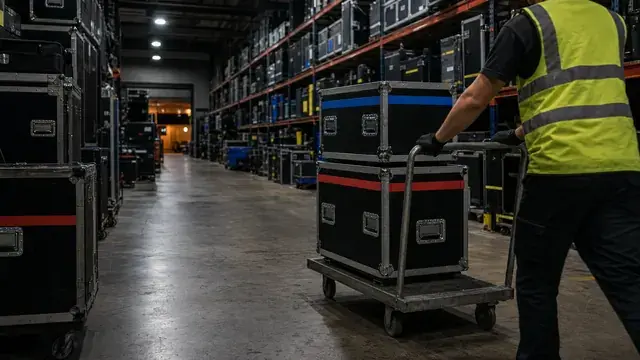
Because most operators price the sub-rental after they price the show. The client rate got set on Monday, and the vendor cost got locked on Wednesday. By the time the flight cases move on Thursday, the gap has already collapsed. In 2026 the fix is not a bigger markup. It is a stricter sequence: confirm the sub-rental cost in writing before the client rate is quoted, price labor higher relative to gear so the sub-rental hit has somewhere to land, and treat freight, insurance, and turnaround as line items rather than as afterthoughts.
Why is sub-rental margin so hard to hold in 2026?
Three reasons at the same time. First, per-show grosses are compressing across most tour sizes, which means the client is less flexible on rate. Second, rental industry operating margins for the trailing twelve months to Q1 2026 came in at 22.9 percent, down from 25.3 percent a quarter earlier, per CSIMarket, so the whole sector is running on tighter unit economics before you even open the sub-rental question. Third, the Rentman "2026 So Far" recap of live event production highlights a specific structural issue: companies are still pricing equipment higher than service, even though labor costs have climbed, which leaves no cushion when a sub-rental hits the P&L. The rental house that prices labor relatively higher has room to absorb a sub-rental. The rental house that packs everything into gear rate does not.
What is the actual math on sub-rental margin?
Start with the sub-rental cost. Not the estimate. The written vendor quote, including delivery, pickup, insurance rider, and any turnaround cleaning or QC time. Add freight both ways if you are moving it. Add a labor line for your own crew handling the arrival, prep, and return. Add a small contingency (typically 5 to 10 percent) for the thing you cannot see at booking time. Now you have the real cost. The client rate goes on top of that, not the other way around. Many of these add-on calculations are simple with a platform like GearShare, but when you're calling your buddy Bob on his cell phone while he's on a show site, details get lost.
Analogous industries confirm the pattern. In construction, the Construction Arbitrage sub-work markup guide puts GC markup on subcontracted work at 15 to 25 percent as the common range, with 20 to 30 percent as the target for sustainable profitability. Live-events sub-rental has a similar shape, but with an added risk premium for on-site failure and last-minute swap-outs. A 15 percent markup is the floor. A 20 to 25 percent markup is the working range on standard-spec gear. Anything unusual (specialty rigging, IP-rated fixtures, redundant systems, foreign-country carnet moves) sits at 30 percent or above, because the risk profile is genuinely different.
When does the math actually break?
Four specific failure modes account for most of the money left on the table.
- Quoting the client before the vendor cost is confirmed in writing. This is the number-one cause of sub-rental losses in every rental house we talk to. The client rate is a number. The vendor cost is a range. The gap between them is where the margin was supposed to live, but you cannot know the gap until both numbers are pinned down.
- Missing the freight line. Round-trip freight for a mid-size sub-rental of professional gear is not a rounding error. On a 3,000 dollar sub-rental it can be 400 to 900 dollars, easily. If freight is not called out as its own line, it is coming out of margin.
- Missing the labor line. Someone at your warehouse is receiving the gear, prepping it, testing it, and returning it. That is real hours. If the sub-rental price to the client does not include your own labor, your own labor is subsidizing the vendor's rate card.
- Missing the turnaround gap. If the gear comes back on Sunday night and needs to go out on Monday morning, the whole shop is in service mode instead of prep mode. That has a cost. Rental houses that track it typically price it at half a day of shop time per sub-rental cycle.
Fix any two of these and the sub-rental margin usually comes back into the target range. Fix all four and sub-rental becomes a genuine profit contributor, not a break-even category.
What does the fix look like on a real deal?
Cost the sub-rental fully, in writing, with freight, insurance, labor, contingency, and turnaround. Print it as a real number. Add the appropriate markup for the risk profile: 20 percent for standard-spec, 25 percent for premium, 30 percent for specialty or cross-border. Quote the client that number, plus your normal ancillary services (crew, transport if separate, on-site tech, and so on). If the client rate needs to come down for competitive reasons, adjust the markup, not the cost basis. If the markup falls below 15 percent, walk. That deal will lose money on a normal show and will lose more money the moment anything goes wrong.
The RentalResult post on protecting re-rental margins puts it well, in the equipment rental context: put vendor cost and customer rate on the same screen, before the transaction is locked in, so you can sanity-check the margin at the point of decision. The live-events version of the same idea: cost the sub-rental fully, tag it to a purchase order in your rental management system, and lock the client quote against that cost, not against last month's rate card.
The 2026 read on sub-rental
Sub-rental is not going away. Utilization is not high enough, tour routing is not stable enough, and rider specs are not narrow enough for any rental house to fill 100 percent of the show book from inventory. What changes in 2026 is that the margin cushion under a sub-rental is smaller, so the process discipline matters more. The operators who compound value on sub-rentals this year are the ones with a written sequence: vendor cost first, freight and labor called out, client rate built on top, markup tied to risk profile. The operators who lose money on sub-rentals this year are the ones still quoting the client before the vendor writes the number down.
GearShare exists to compress the discovery half of that sequence: find the gear, see the availability, get to a real vendor rate faster, and collect cost or need based details in one clean space. The margin discipline is still yours. See how sub-rental discovery works at GearShare.
FAQ
What is the typical sub-rental markup in live events in 2026?
15 percent is the floor, 20 to 25 percent is the working range for standard-spec gear, and 30 percent or above is normal for specialty rigging, IP-rated fixtures, redundant systems, or cross-border moves. Anything below 15 percent generally loses money on a normal show and loses more the moment a swap-out or overtime hit shows up on the ticket.
Should I quote the client before I have the sub-rental cost in writing?
No. That single sequencing error is the number-one cause of sub-rental losses. Confirm the vendor cost in writing first, including freight, insurance rider, and any turnaround handling. Build your client rate on top of that number. If the client is pushing for a same-day quote, hold the price soft until the vendor cost is locked, then commit.
How do I price my own labor into a sub-rental?
As a separate line item. Someone at your shop is receiving the gear, prepping it, testing it, running paperwork, and returning it. Estimate the hours honestly (usually two to six hours per sub-rental cycle for a mid-size deal) and price it at your loaded labor rate. Rental houses that skip this line silently subsidize the vendor's rate card out of their own crew hours.
What counts as a hidden cost on a sub-rental?
Round-trip freight, insurance rider premiums, cleaning and QC time on return, turnaround gap when the gear arrives right before it has to ship out again, and administrative time for the PO, the invoice, and the reconciliation. Any of these can quietly erase a 15 to 20 percent gross margin if it is not called out on the quote before the deal is booked.
Does software actually help with sub-rental margin?
Yes, in one specific way: purpose-built rental management systems let you see the vendor cost and the client rate on the same screen at the moment of booking, which forces a sanity check on the margin before the transaction is locked. General accounting software does not do this well. Any tool that keeps vendor and customer numbers in separate views is not solving the sub-rental margin problem.
How is 2026 sub-rental economics different from 2019 or 2022?
Client rates are less flexible, freight is more expensive, insurance is up, and rental industry operating margins are lower (22.9 percent trailing twelve months to Q1 2026 versus higher pre-2024 averages). The cushion under every sub-rental is thinner. Same process gaps that were survivable in 2019 now show up as red lines on the P&L. Discipline replaces margin as the primary defense.