The 4 AM Wake-Up Call

Why I’m Re-Reading The Innovator’s Dilemma
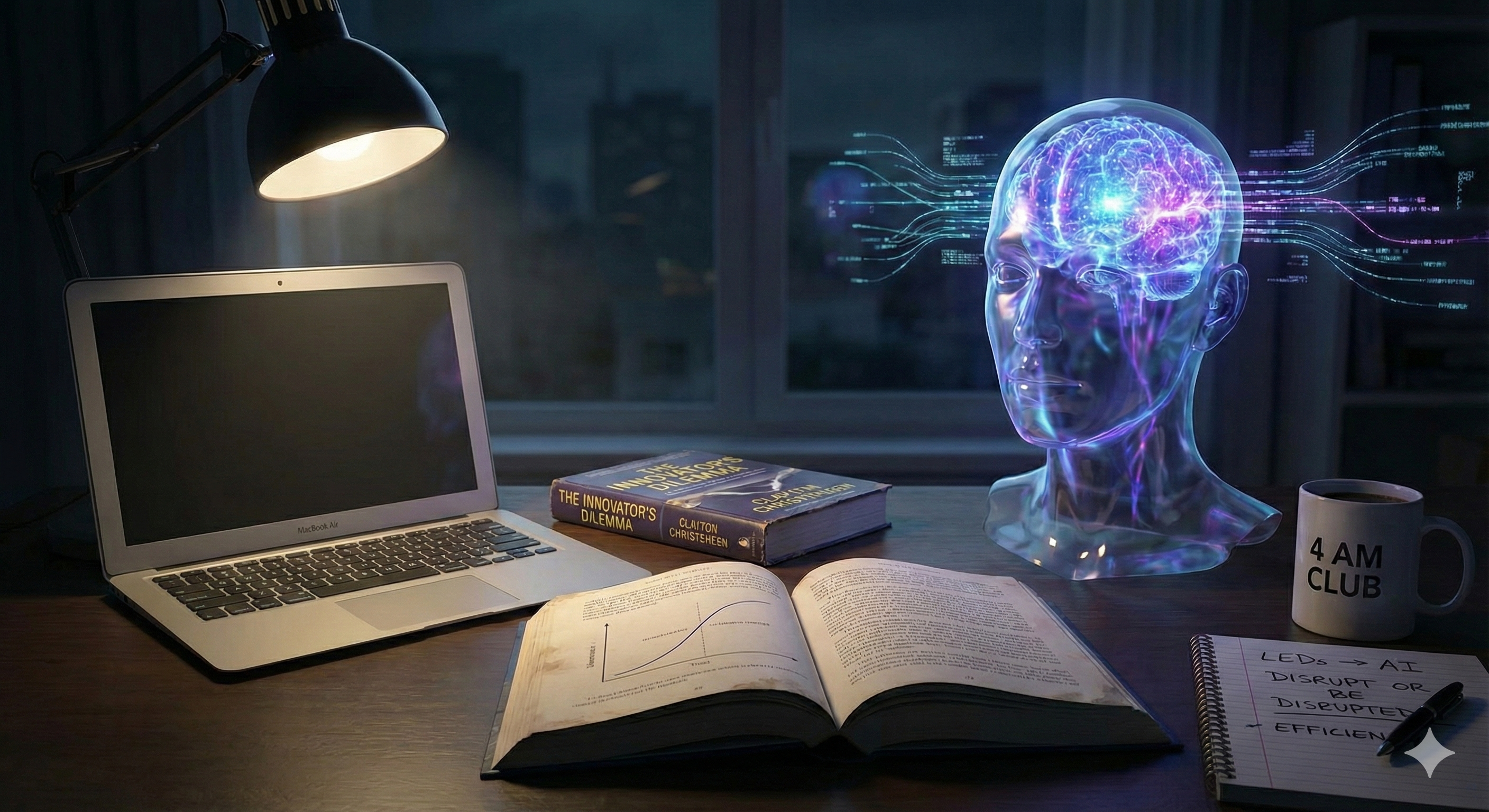
It’s 4:00 AM. The house is pitch black. The world is quiet.
Most people are deep in REM sleep, or maybe awake just enough to wonder what they’ll have for breakfast. Not me! My eyes are open, and my mind is already racing at a hundred miles an hour. I’m not thinking about coffee or eggs; I’m thinking about speed. I’m thinking about how to push harder, move faster, and do more. What am I missing?? 🤯
This is a ritual, a habit and part of my journey. It is the burden and the blessing of an innovator’s mind.
I recently picked up Clayton Christensen’s The Innovator’s Dilemma for the second time. The first time I read it was roughly 20 years ago. Back then, I was building a company around LED lighting distribution. To give you some context, this was a time when commercial LED lighting barely existed. It was crazy expensive, "unproven," and most of the incumbents (initially even including GE, Philips, Sylvania!) laughed it off.
I guess I saw what they didn't... opportunity, trajectory - all built around a need to disrupt an ancient market with only 3 prior "technologies" leading to the modern lightbulb. The candle, incandescent and fluorescent.
Reading it again now, decades later, is a surreal experience. It’s reminding me that my brain is simply wired differently. While most business leaders are content with "good enough," I am obsessively scanning the horizon for the better, simpler, and cheaper way to do stuff.
The Trap of Success...
The core thesis of the book is that great companies fail not because they do things wrong, but because they do everything right. They listen to their customers, they invest in their current technology, and they maximize profits. And in doing so, they leave themselves wide open to disruption from the bottom up.
As an entrepreneur, this terrifies and excites me.
Disruptive technologies usually start out looking "worse" than the status quo. They are cheaper, simpler, but often have lower margins. The big guys ignore them. But then, the tech rapidly gets better. And by the time the giants realize what happened, they are obsolete.
I lived this with LEDs. And I am living it again right now.
Why I’m "Dug In" on AI
If you’ve spoken to me lately, you know I am all in on Artificial Intelligence. To me, AI is the new LED, only exponentially faster and far more impactful.
Just like 20 years ago, I see people dismissing the current wave of tech. They say it "hallucinates" or it's "not ready for enterprise," or it's "taking jobs and ruining everything"
I completely understand these ideas and thoughts, but I see it very differently.
While some focus on the limitations, I am looking at the revolution. I see how this technology will completely rewrite the playbook for my own efforts. But more importantly, I see how it will create massive efficiencies for the live events production and rental industry. Even allowing small businesses to compete at a much larger scale, and large businesses to add efficiencies that enable success and profitability at any scale.
This is an industry I love, but let's be honest, it is ripe for disruption. It is filled with friction, logistics nightmares, and outdated processes. And don't get me started on the CapEx nightmares that have become a ticking time bomb!
Why are workflows so fragmented?
Why is it so hard to scale efficiency?
AI is a once in our lifetime tool that will allow us to automate the mundane so we can focus on the spectacular. It buys back your time! (another favorite book of mine!)
The Responsibility to Disrupt
Being an innovator isn't easy. It’s often lonely. It means looking at systems that everyone else accept as "normal" and feeling a visceral need to break them apart and rebuild better.
When I wake up at 4 AM, it’s because I feel a distinct responsibility. The world demands innovation to move forward. We have a duty to not just participate in our industries, but to evolve them.
If we aren't the ones disrupting ourselves, someone else will. And I don’t know about you, but I’d rather be the disruptor than the casualty. This reminds me of another book (sorry for the theme here.. I swear, I am not pushing you to read more!) by blogger Jeff Jarvis called WWGD - What Would Google Do. It's a book for companies or entire industries facing digital disruption. "Google is going to disrupt your business and eat your lunch, how will you innovate and stop them". That thought has haunted me since reading the book in 2009.
Back to work.
-2.png)