The Freight Problem Live Events Hasn't Solved

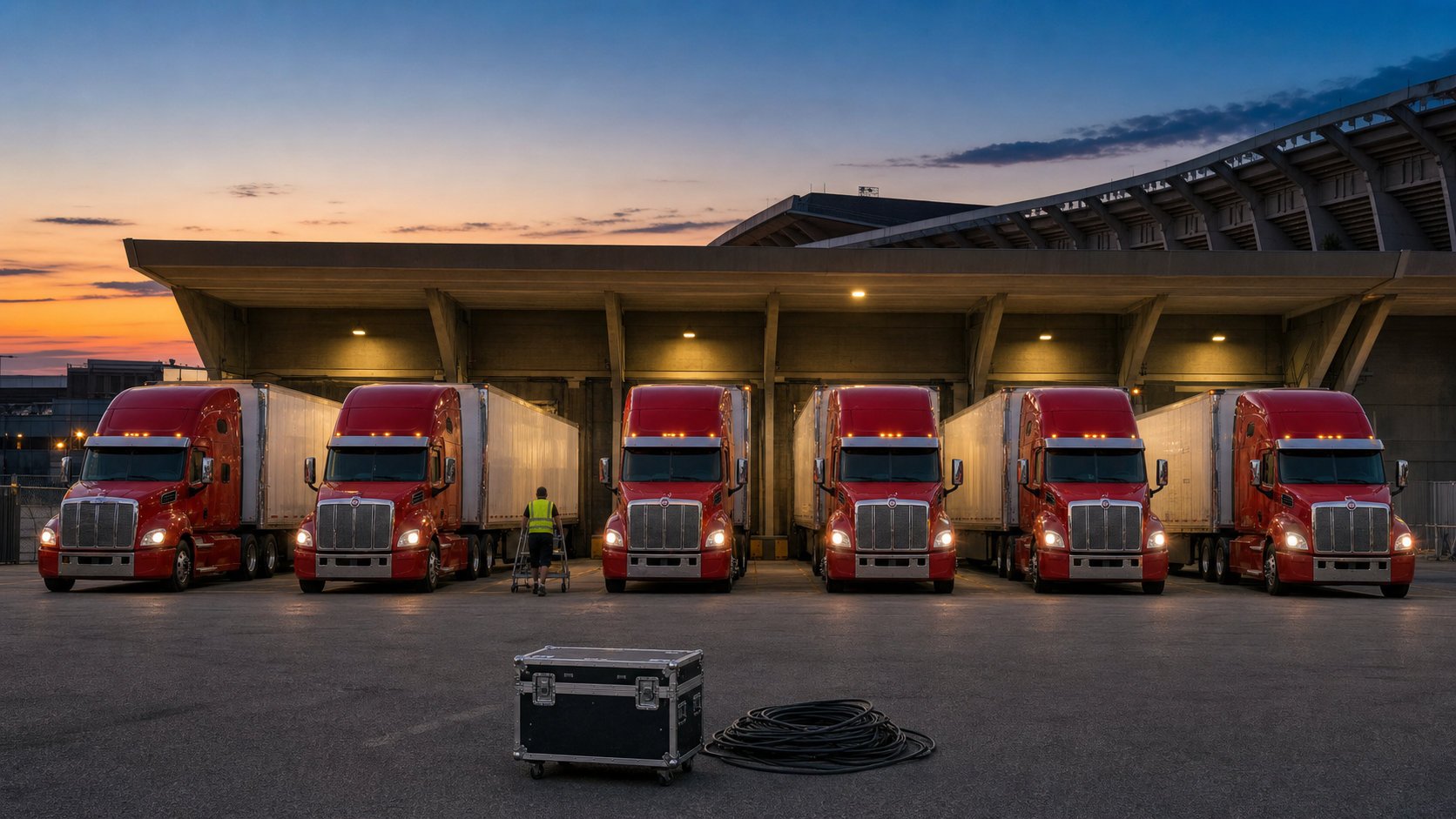
Every summer the touring industry congratulates itself on another season that got through load-in, and every summer it quietly rebooks the same trucks for the same shows without asking whether the freight math still works. It does not. Entertainment trucking is a specialty pool inside a national freight market that is tightening for the first time in nearly two years, drivers keep leaving specialty work for easier dry-van runs, and the assumption that a production can always call three carriers and get three quotes on Tuesday is no longer a safe assumption. This is not a doom piece. The freight side of the business has changed while the booking side has not, and the gap is widening.
The market underneath the market
The specialty entertainment trucking pool sits inside the general freight cycle, which is why it moves later and hurts more. Truckpacker's festival season crunch newsletter framed the 2026 shift plainly: the post-pandemic freight glut is over, capacity is tightening, drivers running tour gear need air-ride trailers, Class A endorsements, and the patience to sit through 14-hour load-outs, and when general rates rise the specialty pool loses drivers to easier dry-van work. The pipeline back is slow because the training and lifestyle filter is narrow. You do not solve a touring driver shortage by dropping a signup bonus into a job board.
The macro numbers put a floor under the trend. PLS Logistics reported that truck transportation employment fell by 4,400 jobs in May 2026 while aggregate contract rates kept climbing, and a March 2026 FMCSA rule narrowed eligibility for non-domiciled commercial learner's permits and CDLs, tightening the supply pipeline further. Truckpacker's August 2026 stat sheet added the specialty edge: California alone cancelled about 13,000 non-domiciled licenses on March 6, and FMCSA's proposed rule codifying an English language proficiency check as an out-of-service violation will land in the same operational window as festival season. None of that reads as a touring story on its face. It becomes one the week the carrier calls to say the driver is gone and the replacement quote is at spot.
Why does the industry keep behaving as if freight is a solved problem?
Because most of the time it is. A booked truck usually shows up. A booked driver usually gets to the venue. The show opens on schedule. But a system that works most of the time by burning through its slack is not a system that works, it is a system that borrows against the next year to close out this one. Production companies who lived through 2019 and 2022 already know what happens when the slack runs out. It is worth naming what the slack actually is: sub-domiciled drivers who took specialty gigs for the lifestyle, small carriers who ran three or four trucks against tour dates because their local freight was slow, and freight brokers who had time to shop three quotes because their books were empty. All three sources of slack are compressing in the same window.
The three quiet compounding pressures
Three pressures are stacking in the same twelve-month window, and each one is manageable alone.
- Driver supply is tightening at the specialty end faster than at the general end, because the specialty end has the harder work and the thinner training pipeline.
- Contract rates are rising off the floor. DAT aggregate contract rates across dry van, reefer and flatbed rose seven cents in June to $2.41 per mile, thirteen percent higher year over year, per Truckpacker's stat sheet. Specialty rates are moving in the same direction, off a higher base.
- Regulatory changes are compressing the pool. The non-domiciled CDL rule, the ELP enforcement rule, and state-level license cancellations are all landing inside the same booking window.
Together they mean the same tour that priced at X in 2024 does not price at X in 2026, and the difference is not a rounding error. Production budgets that assumed flat freight are quietly bleeding margin.
What the operating side already knows
Ask any tour manager who has been on the road since 2018 and you will hear the same list. The carriers who used to answer the phone at 6 a.m. do not always answer now. The drivers who worked three tour weeks in a row now split their time between tour work and steadier home-time runs. The broker who used to have three trucks against your dates has two, and the third is a spot quote. The Truckpacker festival season logistics piece laid out the operating discipline that gets crews through August: pack to the next load-out not just this one, lock dimensions and weights early so the pack is not a data disaster, make the plan visible to everyone who touches the truck, and treat sub-rentals as first-class citizens in the pack so return deadlines are flagged.
Those are good operating rules. They are not a substitute for a healthier freight market. They are the coping mechanism a mature industry uses when the underlying supply is short.
What would treating this seriously look like?
It would start with production companies pricing freight the way they price labor: as a variable line with a documented pass-through rate, not a fixed number in a spreadsheet from last year. It would include a written carrier plan for every tour with a primary, a secondary, and a spot ceiling, so the production manager is not shopping the phone at midnight. It would mean that manufacturers, rental houses, and touring productions all talk about the same driver pool as a shared piece of infrastructure that they are all draining, rather than a private problem each one solves separately. And it would mean the trade press covers freight the way it covers riders and rigging, which is to say, weekly and with real numbers.
That is not the industry we have. The industry we have books the trucks, hopes the drivers show, absorbs the spot quotes when they do not, and repeats the pattern next summer. Something changes when that pattern breaks, and the pattern is closer to breaking than the room usually admits.
Frequently Asked Questions
Is the 2026 driver shortage different from prior cycles?
Yes and no. The absolute headcount picture is genuinely muddier: the American Trucking Associations stopped publishing its shortage estimate and its chief economist reframed the problem as driver quality, not raw supply. But the specialty pool feels tighter because the CDL eligibility rules narrowed in March 2026, non-domiciled licenses have been cancelled at the state level, and the specialty pipeline is slow to backfill even when general trucking recovers.
How much have entertainment freight rates actually moved?
Aggregate DAT contract rates rose to $2.41 per mile in June 2026, thirteen percent higher year over year, per Truckpacker. Specialty entertainment trucking moves off a higher base than dry van because of the air-ride trailer requirement and driver skill premium, so a production booking today against a 2024 budget is generally looking at a mid-to-high single-digit percent increase before any spot exposure.
Why cannot production companies just use general freight carriers?
Two reasons. First, general dry-van equipment is not built for the shock loading and case-height requirements of touring gear, so air-ride trailers are effectively mandatory for anything above a corporate roadshow. Second, load-in schedules require drivers who accept 14-hour teardowns, overnight deadheads, and last-minute routing changes. That skill set is a filter, and general freight carriers usually do not cross it without a wage premium that erodes the savings.
What is the practical exposure for a summer 2026 festival run?
The exposure has three parts. Base rate creep, documented at roughly mid-single-digit percent above 2024. Spot exposure on the last-mile fill when a booked driver falls off, which carriers do not publish but production managers describe as materially higher than in 2023. And schedule slippage when the replacement truck is a day out. The compounding cost is bigger than the rate move alone.
Are cross-border tours getting harder?
Yes, per the C.H. Robinson July 2026 market update: Mexico routes face tight capacity, border delays, and firm pricing as exports grow, while Canada remains softer amid muted demand and USMCA uncertainty. For touring productions that means the Mexico leg is where the surprise usually lives, and the Canada leg is where the softness gives room to negotiate. Neither is a market to book blind.
What should a production manager change first?
Change the assumption that a booked carrier is a locked carrier. Build a written primary, secondary, and spot ceiling into every tour freight plan. Document sub-rentals with return deadlines in the truck pack. And stop pricing freight as a fixed line. The line is variable, the volatility is real, and the client relationship survives better when the pass-through is disclosed upfront.
GearSource has been watching how touring freight touches marketplace pricing for the last several cycles, and the pattern this year is a real inflection, not a seasonal blip. More at gearsource.com.